Nine years of step counts, all laid out at once
The iPhone had been counting all along. Without my ever setting it up, it had recorded my steps since 2016. When I finally laid nine years of footprints side by side, a shape emerged — mostly quiet, and every so often, exploding.
When the full dataset was exported from the iPhone Health app, roughly nine years of step counts came out at once. Without my ever setting it up, it had been quietly counting since 2016. So I lined them all up. N=1 — one person’s record of their own footprints.
- The Wide View — Mostly quiet, occasionally exploding
- The Top Ten — Not the steady-daily-grind type
- The Biggest Day — The river became the map of a day
- Two Weekends — A record gives distance back to memory
- Year by Year — Walking has come back into daily life
- A Side Note — What happens the day after a long walk?
- In Closing — That number is still growing, today
A built-in app that keeps counting your steps
Health is the data-logging app that ships with every iPhone. Without any setup, the phone’s motion sensors automatically record steps, flights climbed, and an estimate of distance walked. Because the data accumulates over years, exporting it lets you look back, all at once, on just how much you’ve walked. Step counts and distances are smartphone estimates, not precise measurements.
01 / THE WIDE VIEWMostly quiet, occasionally exploding
Start with the wide angle. The daily average is 6,331 steps, with a median of 5,958. An unremarkable number. But every so often, it explodes. A few days stick out of the chart like needles.
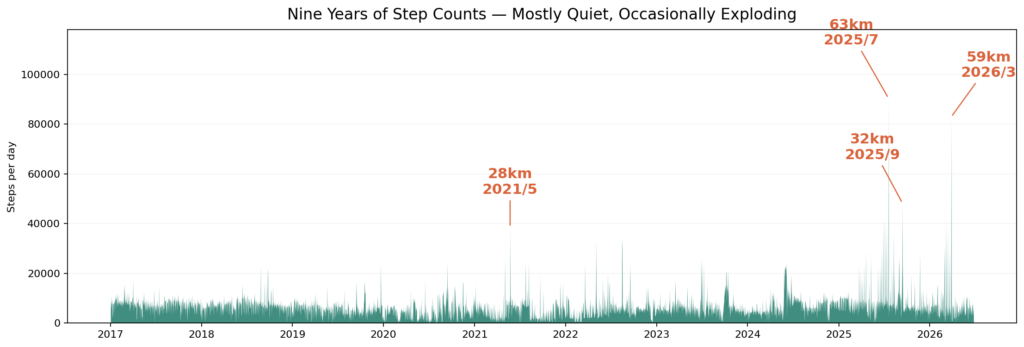
Nine years of daily step counts. Quiet around 6,000 most days; the needles are the long-distance walks.
The highest is July 19, 2025: 90,498 steps, 63 km — in a single day. The total distance is striking too. Over nine years, about 14,000 km, or 22 million steps. That is more than a third of the way around the Earth (roughly 40,000 km), covered on foot.
02 / THE TOP TENNot the steady-daily-grind type
Days over 30,000 steps numbered just 14 across nine years. Days over 50,000 steps: only two. A genuinely rare event. The top two are 63 km and 59 km — longer than a marathon, on foot.
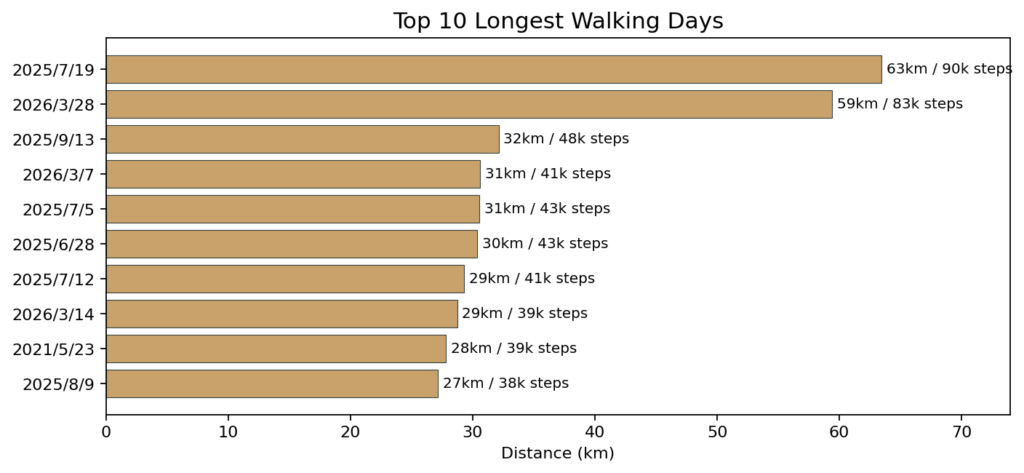
The ten longest days by distance. First is 63 km / 90,498 steps; second, 59 km / ~83,000 steps.
Seen this way, my walking is not the steady-daily-grind type. Usually low-power, occasionally one enormous burst. That seems to be the shape of it.
03 / THE BIGGEST DAYThe river itself became the map of a day
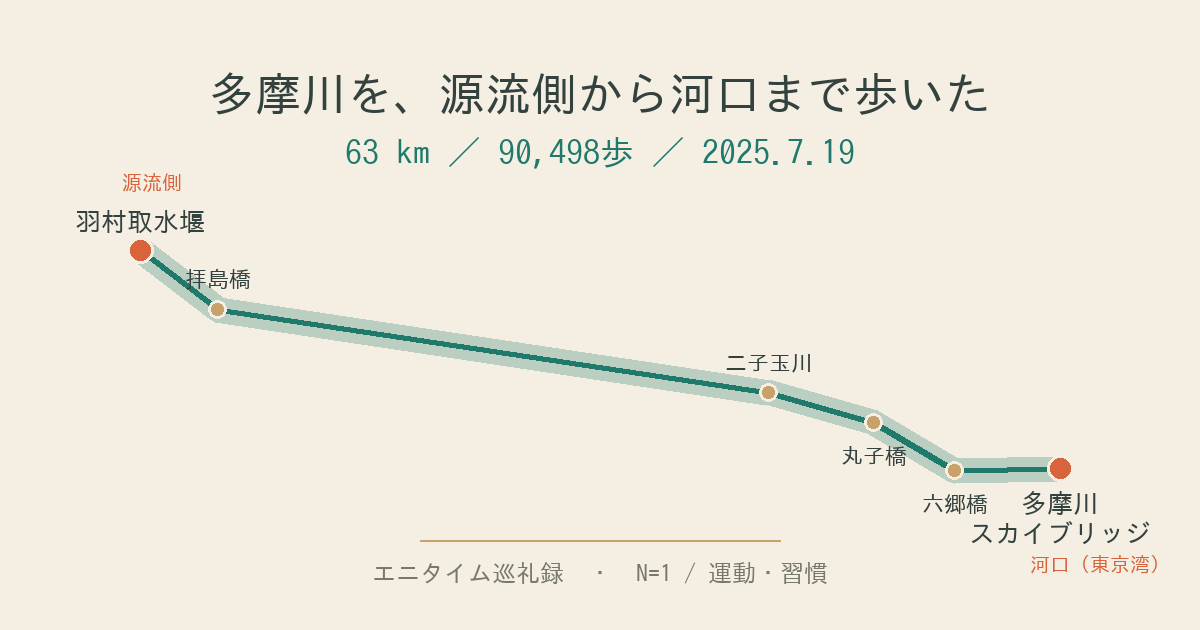
The day at the very top, July 19, 2025. Looking back, this was the day I walked the Tama River. From Hamura Weir on the upstream side, to the river mouth on the Kawasaki side. Along the Tama River, almost in a single line.
Leaving Hamura, then Haijima Bridge — still upstream, with wide riverbanks. At Futako-tamagawa the river suddenly opens up; roughly the halfway point. Past Maruko Bridge comes the lower river, the surface broadening. By Rokugo Bridge there is the smell of the tide and a sea breeze. And then the Tamagawa Sky Bridge — Haneda Airport on the far bank. This is the river mouth.
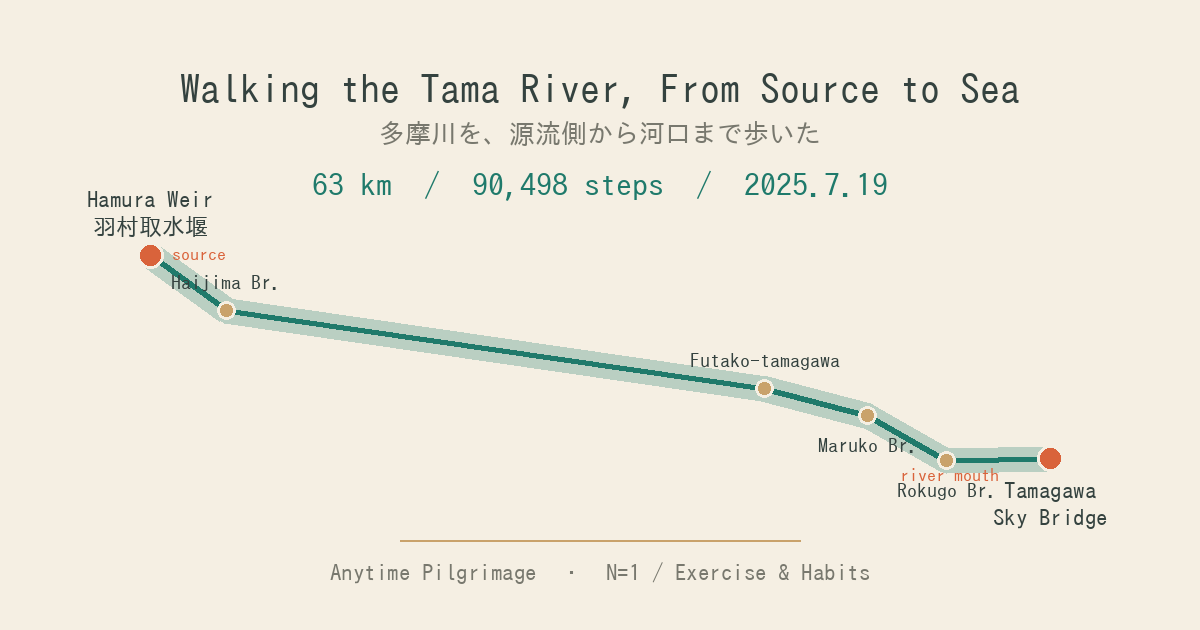
Hamura Weir → Haijima Br. → Futako-tamagawa → Maruko Br. → Rokugo Br. → Tamagawa Sky Bridge (river mouth) / approx. 63 km, 90,498 steps (Jul 19, 2025)
The distance: 63 km, 90,498 steps.
The river itself became the map of a single day.
04 / TWO WEEKENDSA record gives distance back to memory
Inside the data were two weekends I remember clearly. September 13–14, 2025: 32 km on the 13th, 15 km on the 14th. About 47 km over two days. March 28–29, 2026: 59 km out of nowhere on the 28th, then another 13 km on the 29th. About 72 km over two days.
While walking, you are just putting one foot in front of the other. But seeing it later as numbers, there is a small surprise: “I really covered that much that day.” A record gives distance back to memory.
05 / YEAR BY YEARWalking has come back into daily life
Averaged by year, there are gentle valleys and peaks. 2020 was the low point at 4,597 steps a day. From there it climbed back, reaching 8,342 steps in 2025 — the highest of the nine years. The long-distance days also cluster from 2025 onward.
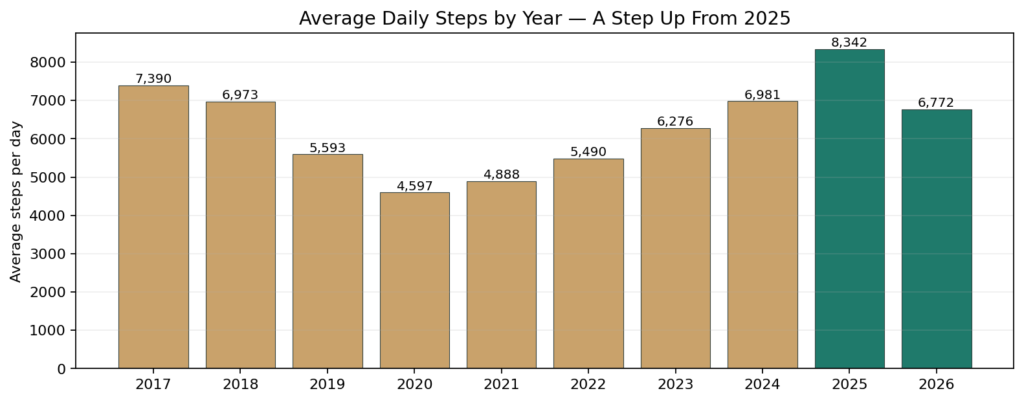
Average daily steps by year. 2020 is the low at 4,597; 2025 the high at 8,342, the most of the nine years.
Over the last year or two, walking has come back into daily life. The chart simply reflects that.
06 / A SIDE NOTEWhat happens the day after a long walk?
While I was at it, I cross-referenced the data with Oura Ring records: “After a day of heavy walking, what does recovery look like?” The method is the same as before — shift the Oura side by one day and join it to the walking day.
The result was a little surprising. Even the morning after a big walk, HRV and resting heart rate do not collapse much. Even after days over 25,000 steps, the sleep score was if anything slightly higher, and sleep duration a little longer.
07 / IN CLOSINGThat number is still growing, today
Lining up nine years of footprints, what emerged was something simple. Most days can be quiet. But a few times a year, the needle swings all the way. That single day is what makes the chart interesting.
The total distance is about 14,000 km. That number is still growing, a little, today.
No rush. Your journey.小さな一歩も、旅のうち。


コメント